
Why Compression Matters for Beginners
Every golf ball has a compression rating, roughly speaking, how hard you need to hit the ball to compress it properly at impact. A Pro V1 has a compression of 90. A Callaway Supersoft has a compression of 38.
When an average male golfer swings at 85 mph and hits a compression-90 ball, they do not fully compress it. The ball springs off the face too early, the energy transfer is inefficient, and the distance they should be getting simply does not happen. The ball also feels harder than it should.
A lower compression ball deforms more easily, which means it compresses fully at lower swing speeds, transfers energy properly, and produces the launch and spin characteristics it was designed to produce. For most beginners and golfers with swing speeds under 85 mph, the ideal compression range is 35 to 65.
What Beginners Should Look for in a Golf Ball
Low Compression (under 65)
Covered above. This is the single most important spec for any golfer who does not have a fast, consistent swing.
Straight Ball Flight
Balls engineered to reduce side spin keep you in play more often. Bridgestone's e-series and Maxfli's StraightFli are purpose-built for this. Straighter flight lowers your score faster than any other equipment change.
Durability
Urethane cover balls (tour balls) scuff easily on cart paths and mis-hits. Ionomer and Surlyn covers are much harder and will survive a full round looking nearly new. As a beginner, this matters.
Price
You will lose golf balls. Everyone does. A two-piece ionomer ball at $20-$25 a dozen gives you real performance without the anxiety of fishing a $5 ball out of the hazard.
The Best Beginner Golf Balls in 2026
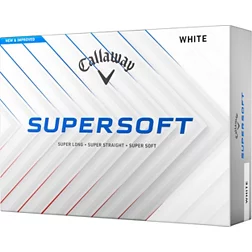
Callaway Supersoft
Best for: Beginners, very slow swings, maximum forgiveness
Compression
38
Cover
Trionomer
Construction
2-piece
Dimples
332
The Supersoft is the easiest recommendation in beginner golf. Callaway engineered it specifically around slow swing speeds, and a compression of 38 means virtually any golfer can compress it properly at contact. You will get the distance you're supposed to get from this ball, which is not something you can say about a Pro V1 in a beginner's hands. The feel off the putter is genuinely soft and satisfying, and the HEX Aerodynamics dimple pattern keeps ball flight stable even on mis-hits. It is also cheap enough that losing one in the water doesn't ruin your round.
Pros
- +Ultra-low compression suits any swing speed
- +Very straight ball flight reduces side spin
- +Soft feel off the putter and wedge
- +Affordable enough to not stress about losing one
Cons
- -Limited greenside spin for more advanced shots
- -Ionomer cover scuffs faster than urethane
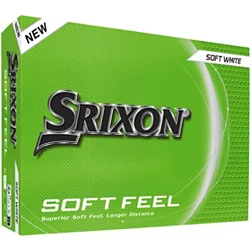
Srixon Soft Feel
Best for: Budget-conscious beginners, anyone wanting better-than-expected quality
Compression
60
Cover
Ionomer
Construction
2-piece
Dimples
338
Srixon is a full tour-level brand that most casual golfers overlook. That gap between perception and quality is exactly why the Soft Feel is such a bargain. It performs noticeably better than its price suggests, with a spring-like core that adds distance for moderate swing speeds and a 338-dimple cover that holds a consistent flight. The feel off the putter is soft and responsive. If you want a ball that outperforms every other option at this price point, this is it.
Pros
- +Noticeably better quality than the price implies
- +338-dimple pattern gives consistent ball flight
- +Good feel off the putter for the price
- +One of the cheapest playable balls available
Cons
- -Less forgiving on off-center hits than the Supersoft
- -Minimal greenside spin
Wilson Staff Duo Soft
Best for: Senior golfers, juniors, swing speeds under 65 mph
Compression
29
Cover
Ionomer
Construction
2-piece
Dimples
302
The Duo Soft has the lowest compression rating of any golf ball in production, and that matters more than most people realize. If your swing speed is under 65 mph, a compression-60 ball is already borderline too firm for you to compress properly. A compression-29 ball eliminates that problem entirely. You will make solid contact, generate proper spin, and feel the ball respond the way it's supposed to. For senior golfers or anyone with a slower, smoother tempo, this is the most honest recommendation we can make.
Pros
- +Lowest compression of any production ball at 29
- +Produces proper distance at swing speeds under 70 mph
- +Extremely soft feel on every shot
- +Excellent for senior and junior golfers
Cons
- -Lower trajectory than firmer balls
- -Less distance for faster swingers
Titleist TruFeel
Best for: Beginners who want Titleist consistency without the premium price
Compression
60
Cover
TruFlex
Construction
2-piece
Dimples
376
Titleist makes the most consistent golf balls on the market at every price tier. The TruFeel is their entry-level offering, and it carries the same quality control and manufacturing precision as the Pro V1, just without the urethane cover and multi-layer construction. The 376-dimple TruFlex cover reduces side spin for a straighter flight, and the soft feel is noticeably better than most ionomer balls in this price range. If the Titleist name means something to you, this is the one to buy.
Pros
- +Titleist quality control and consistency at a low price
- +376 dimples reduce side spin for straighter flight
- +Better feel than most budget ionomer balls
- +Reliable performance round to round
Cons
- -Slightly firmer feel than Supersoft or Duo Soft
- -No urethane short-game performance
Maxfli SoftFli
Best for: Golfers who prioritize feel above everything else
Compression
35
Cover
Ionomer
Construction
2-piece
Dimples
392
The SoftFli's 392-dimple design is one of the highest dimple counts you'll find on any golf ball, and it shows in the flight. Shots hold their line even in a crosswind better than most budget balls. Compression of 35 means it is nearly as soft as the Duo Soft while adding slightly more distance for moderate swing speeds. The feel off the putter is genuinely luxurious for a ball at this price. If you are choosing a ball primarily on feel, the SoftFli is hard to beat under $25 a dozen.
Pros
- +392-dimple pattern produces exceptionally stable ball flight
- +Compression 35 delivers distance and softness
- +Premium feel for the price tier
- +Widely available at Dick's Sporting Goods
Cons
- -Limited spin control around the greens
- -Not available through as many channels as Callaway or Titleist
Bridgestone e6 Soft
Best for: Beginners who struggle with a slice or hook
Compression
50
Cover
Surlyn
Construction
2-piece
Dimples
326
Bridgestone engineered the e6 line around one specific problem: side spin. The 326-dimple Surlyn cover and core design actively reduce the side spin that causes slices and hooks. If you consistently curve the ball and want a ball that fights back against your miss, the e6 Soft does that better than any other ball at this price. The soft feel is a bonus. This is the most corrective ball available for beginners who struggle with direction.
Pros
- +Engineered specifically to reduce side spin
- +Noticeably straighter flight for slicers and hookers
- +Soft compression suitable for moderate swing speeds
- +Durable Surlyn cover lasts multiple rounds
Cons
- -Not the longest option if distance is your priority
- -Minimal greenside performance
Quick Comparison
| Ball | Compression | Cover | Best For | Price |
|---|---|---|---|---|
| Callaway Supersoft | 38 | Trionomer | Best Overall | ~$22/dozen |
| Srixon Soft Feel | 60 | Ionomer | Best Value | ~$20/dozen |
| Wilson Staff Duo Soft | 29 | Ionomer | Best for Very Slow Swings | ~$19/dozen |
| Titleist TruFeel | 60 | TruFlex | Best Titleist Option | ~$25/dozen |
| Maxfli SoftFli | 35 | Ionomer | Softest Feel | ~$22/dozen |
| Bridgestone e6 Soft | 50 | Surlyn | Best for Straight Flight | ~$22/dozen |
Frequently Asked Questions
Should beginners use a Pro V1?
No. The Pro V1 is a compression-90 urethane tour ball built for swing speeds above 95 mph. Most beginners cannot compress it properly, which means less distance, a harder feel, and no benefit from the urethane short-game performance they can't access yet. Save $30 a dozen and play the Supersoft until your swing speed and consistency improve.
Does ball color affect performance?
No. White, yellow, matte, and high-visibility balls all perform identically. Ball color is purely a visibility and personal preference choice. Many beginners find yellow or high-vis balls easier to track in flight and locate in rough.
How many golf balls should a beginner buy?
Buy at least two dozen for 18 holes until you know your average loss rate. Most beginners lose 3-5 balls per round, sometimes more on courses with water. Budget balls at $20-25 a dozen mean you can keep a full bag without worrying about each shot.
When should I upgrade to a better ball?
When your swing speed consistently reaches 85 mph and you're making centered contact more often than not. At that point, a mid-range urethane ball like the Maxfli Tour or Srixon Q-Star Tour starts delivering real performance gains, especially around the greens.